
Abstract
Temperature measurement on rotating components is a recurring requirement in the validation and characterization of engines, compressors, turbines, bearings, transmissions, and electric machines. Such measurements are commonly performed in automotive testing, aerospace test programs, and a wide range of industrial rotating machinery applications. The main technical challenge lies in transmitting low-level sensor signals reliably from the rotating element to the stationary acquisition system without degrading measurement quality.
Among the available transmission architectures, precision slip rings provide a robust wired solution for transferring signals from thermocouples and RTD sensors across the rotating interface. In contrast with telemetry or other wireless transmission systems, slip-ring-based architectures support continuous transmission, require no onboard power source, are not subject to RF environment constraints, and do not inherently impose bandwidth limitations. These characteristics make them particularly suitable for applications where signal stability, repeatability, and metrological performance are critical, especially during severe-duty or long-duration test campaigns.
1. Introduction
Thermal characterization of rotating systems is essential for understanding component behavior under representative operating conditions. In many applications, temperature must be measured directly on rotating subassemblies such as shafts, rotors, bearing locations, wound components, or mechanically loaded interfaces. These measurements are typically used to:
- quantify thermal gradients and local hot spots,
- validate thermal design assumptions,
- assess behavior under transient or steady-state loading,
- support durability and endurance testing,
- detect abnormal heating associated with friction, lubrication issues, or electrical losses.
The difficulty of such measurements does not generally arise from sensor implementation alone, but from preserving the integrity of the sensor signal while crossing the rotating-to-stationary boundary. This issue is particularly important for thermocouple measurements, where low signal levels and sensitivity to parasitic junctions can significantly affect uncertainty.
2. Measurement Chain Considerations
In a rotating thermal measurement chain, the overall quality of the result depends on both the sensor installation and the transmission architecture. When thermocouples or RTDs are installed on a rotating part, the transmission interface must introduce minimal disturbance in order to preserve the validity of the acquired data.
For this reason, the electrical behavior of the slip ring is a key design parameter. In particular, contact resistance level and stability directly influence signal consistency. Our precision slip rings are characterized by a contact resistance below 100 mΩ (3 sigma), which contributes to reducing contact-related fluctuations and improving the stability of transmitted signals.
This characteristic is especially relevant in applications involving low-level analog measurements, repeated test cycles, or long-duration endurance programs, where even small transmission instabilities may affect trend analysis or uncertainty budgets.
3. Architecture Options for Thermocouple and RTD Transmission
Several measurement chain architectures may be implemented depending on the required accuracy level, available installation volume, and environmental constraints.
3.1 Direct Transmission Through the Slip Ring
In the simplest configuration, the sensor signal is routed directly from the rotating sensor to the stationary acquisition system through the slip ring. This architecture is suitable when the transmission quality is sufficient to meet the target uncertainty and when system simplicity is preferred.
For RTD and thermocouple signals, this approach benefits from the continuous wired path provided by the slip ring and avoids the complexity associated with onboard wireless transmission systems.
3.2 Rotor-Side Thermocouple Signal Conditioning
For higher-accuracy applications, certain versions may be equipped with thermocouple signal conditioners integrated beneath the rotor, upstream of the rotating interface. In this configuration, the raw thermocouple signal is conditioned as close as possible to the sensor before transmission through the slip ring.
This approach offers several advantages:
- reduction of the sensitivity of the transmitted signal to contact-related perturbations,
- improved robustness of the measurement chain,
- better suitability for demanding thermal validation programs,
- easier control of the metrological behavior of the overall architecture.
This type of configuration is particularly relevant when the application requires the highest level of confidence in small thermal variations or when the test environment is especially severe.
3.3 Use of Thermocouple-Grade Wiring on the Stator Side
In architectures without onboard conditioning, the stator-side wiring can be manufactured using thermocouple-grade conductors. This helps preserve the continuity and homogeneity of the measurement chain and minimizes errors associated with intermediate junctions.
For thermocouple measurements, this design choice is important because each unintended material transition can generate additional parasitic thermoelectric effects. Maintaining material consistency along the measurement path therefore contributes to reducing potential sources of error.
4. Technical Performance Range
Precision slip rings intended for demanding thermal test applications are typically designed to operate over a broad range of mechanical and environmental conditions. The performance range of our standard and special versions includes:
- maximum rotational speed up to 12,000 rpm in standard configurations,
- maximum rotational speed up to 20,000 rpm in special configurations,
- operating temperature range from -40 to +120 °C,
- service life of approximately 100 million revolutions in standard versions,
- optional versions with endurance capability up to 10 times greater.
Such durability levels make these devices suitable for extensive validation programs, including endurance campaigns representative of full vehicle lifetime operation, typically on the order of 200,000 to 300,000 km equivalent usage.
5. Representative Application Cases
5.1 Engine Dynamometer Testing
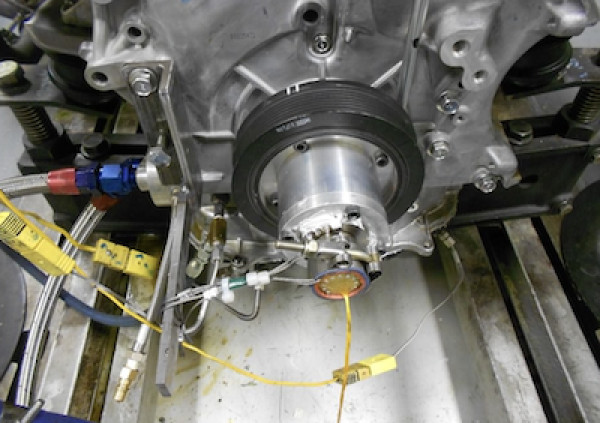
In an engine dynamometer setup, the slip ring is typically mounted at the end of the crankshaft. Thermocouples installed in instrumented regions of the engine are routed to the rotating interface in order to transmit temperature measurements during operation.
This configuration enables monitoring of thermally sensitive areas under representative load conditions. A typical example is the measurement of bearing temperature under high mechanical load, with the objective of detecting abnormal heat generation that may indicate accelerated degradation, lubrication deficiency, or an emerging failure mode.
5.2 Automotive A/C Compressor Testing
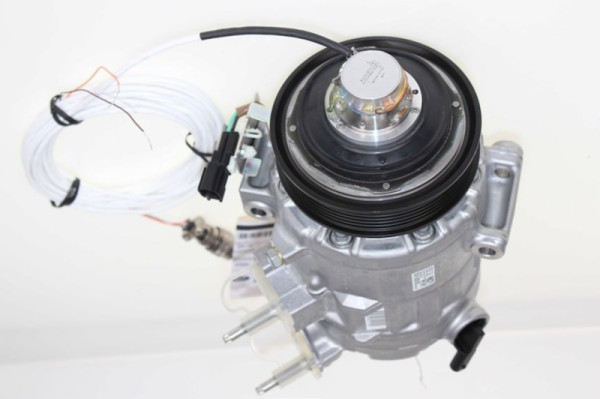
Automotive air-conditioning compressors constitute another representative use case. Compressor engagement increases the mechanical load on the engine and introduces thermal effects that may be relevant both for performance assessment and durability evaluation.
By integrating thermocouples on the compressor and using a slip ring mounted at the shaft end, temperature measurements can be performed under actual operating conditions, either on a test bench or directly on the vehicle. Depending on the required metrological performance, the signal may be transmitted either directly or after rotor-side conditioning.
5.3 DC Motor Testing
In the testing of DC motors, temperature measurement may be required on the armature, shaft, bearings, or other regions close to the rotor. These measurements are used to characterize thermal rise under load, evaluate thermal behavior, and support endurance validation.
In this context, the precision slip ring provides a stable and repeatable transmission solution for temperature signals, including under varying speed and load conditions. This is particularly valuable when thermal behavior must be correlated with electrical loading, duty cycle, or mechanical operating conditions.
6. Discussion
The use of precision slip rings for temperature measurement on rotating systems should be considered in relation to the specific objectives of the test program. Wireless architectures may be attractive in some cases, but wired transmission through a slip ring remains highly relevant whenever long-duration operation, transmission continuity, and controlled metrological behavior are required.
The main technical advantages of the slip-ring-based approach can be summarized as follows:
- continuous transmission without onboard batteries,
- no dependence on RF propagation conditions,
- no intrinsic bandwidth limitation associated with wireless telemetry,
- compatibility with severe-duty and endurance testing,
- suitability for low-level sensor signals when the rotating interface is properly designed.
When combined with appropriate sensor integration practices and, where required, rotor-side signal conditioning, this architecture can provide a high level of confidence in the resulting thermal data.
7. Conclusion
Precision slip rings constitute a well-established and technically robust solution for temperature measurement on rotating components and rotating shafts. Their relevance is particularly strong in applications requiring reliable transmission of thermocouple or RTD signals under demanding mechanical and environmental conditions.
Owing to their low contact resistance, broad operating envelope, high endurance capability, and the possibility of integrating thermocouple signal conditioning on the rotor side, these systems meet the requirements of advanced thermal test programs involving rotating machinery.
In applications where measurement integrity, repeatability, and long-term robustness are primary concerns, precision slip rings remain a highly effective architecture for the instrumentation of rotating systems.
 +33 1 46 91 93 32
 Contact form
 Subscribe to the newsletter