

Moving from Subjective Evaluation to Reproducible Measurement
During the design or optimization phases of a seat, handle, or human-equipment interface, comfort is often assessed through user feedback or qualitative tests. While useful, these methods have significant limitations:
- Subjectivity: perceptions vary between individuals, making it difficult to compare two prototypes.
- Lack of granularity: impossible to precisely identify areas of overpressure or imbalance.
- Limited reproducibility: test conditions are not always controllable, complicating design iterations.
Result: costly prototypes, unexpected customer feedback, and extended development timelines. For design offices, ergonomists, or equipment manufacturers, the challenge is clear: an objective method is needed to quantify contact pressure distribution.
The Solution: A Pressure Mat for Precise Mapping
Pressure mapping meets this need by providing a spatial and quantitative image of the forces exerted on a surface. Unlike a single-point sensor, a pressure mat covers the entire contact area with sufficient resolution to detect local variations.
Operating Principle
-
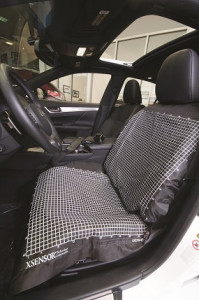
Sensor Mat: a flexible and thin matrix, composed of hundreds or thousands of capacitive sensors, is placed between the user and the surface to be tested (seat, backrest, handle, etc.).
- Spatial resolution: typically on the order of a few millimeters between each sensor, for fine detection of pressure peaks.
- Measurement range: adapted to low to moderate pressures (from a few kPa to several hundred kPa), typical of human-equipment interfaces.
- Minimal thickness: the mat must be thin enough not to disturb the measured interface (a few tenths of a millimeter).
-
Data Acquisition: an electronic module collects sensor signals and transmits them to analysis software via a USB or wireless connection.
- Sampling frequency: adapted for static or dynamic tests (several Hz to track movements).
- Calibration: modern systems do not require recalibration between sessions, ensuring optimal reproducibility.
-
Analysis and Visualization: the software generates a real-time color map with integrated analysis tools:
- Pressure display: color scale to visualize areas of overpressure or underpressure.
- Data export: numerical values (maximum, average pressure, contact surface) and images for technical reports.
- Variant comparison: overlay of maps to assess the impact of a material or geometry change.

Why Is This Approach Suitable for Human-Equipment Interfaces?
Applications in ergonomics and seat design present specific constraints that pressure mapping helps overcome:
- Non-planar and deformable surfaces: a flexible mat adapts to the curves of a backrest or seat, unlike a rigid sensor.
- Non-intrusive measurements: the minimal thickness of the mat avoids altering the user’s perception, preserving test validity.
- Dynamic analysis: the ability to record continuous data allows studying pressure evolution during movements or prolonged sessions (e.g., force redistribution after 30 minutes of sitting).
- Reproducibility: quantitative data facilitates comparison between different prototypes or materials, reducing the number of necessary iterations.
Practical Implementation: Measurement Chain and Integration
To deploy a pressure mapping solution, here are the key elements to consider:
-
Mat Selection:
- Size and shape: adapted to the surface to be measured (e.g., rectangular mat for a seat, circular mat for a handle).
- Resolution: the higher the sensor density, the more precise the detection of local variations.
- Compatibility: ensure the mat supports usage conditions (temperature, humidity, mechanical stress).
-
Acquisition System:
- Connectivity: USB for laboratory use, wireless for real-world testing.
- Autonomy: important for mobile measurements (e.g., tests on vehicle seats in motion).
-
Analysis Software:
- Essential features: real-time visualization, data export, comparison tools, report generation.
- Compatibility: integration with CAD or simulation tools for a seamless workflow.
-
Test Protocol:
- Standardization: define reproducible test conditions (user position, duration, environment).
- Results analysis: identify critical areas (pressure peaks) and correct them through design adjustments.
Recommended Product
To meet these needs, a complete solution like LX100 offers an integrated measurement chain, combining a high-resolution pressure mat, acquisition module, and analysis software. This approach enables objective quantification of comfort and ergonomics for human-equipment interfaces while optimizing design and validation phases.
 +33 1 46 91 93 32
 Contact form
 Subscribe to the newsletter