
Customer challenge and requirements
In industrial processes involving chemical agitators, controlling the torque applied by the motor and precise temperature monitoring as close as possible to the reaction zone are essential. This data enables process yield optimization, operational safety, and a better understanding of the mixture’s behavior under real conditions. Our customer, facing accessibility constraints on their installation, was seeking a reliable measurement solution that was non-intrusive on the agitator side and compatible with a rotating environment. We studied various configurations to meet these requirements while optimizing overall cost and mechanical integration.
PM Instrumentation solutions
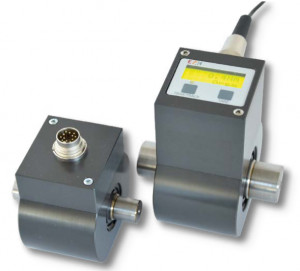
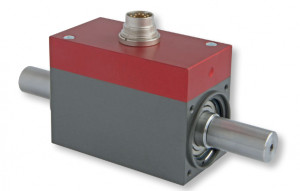
Option 1 – Torque meter on motor side + telemetry for thermocouples
Installing a torque meter at the motor output enables precise torque monitoring without modifying the existing assembly. On the agitator side, thermocouples are positioned to record temperature measurements. Temperature data from the thermocouples is transmitted via a telemetry system, ideal for measurements on rotating shafts. Main advantage: no mechanical intervention on the existing assembly.

Option 2 – Torque meter on motor side + radial slip ring
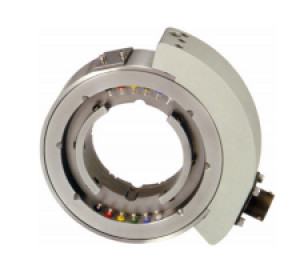
This solution also relies on a torque meter on the motor side. Thermocouple signal transmission is ensured via a radial slip ring (also called hollow shaft slip ring), suitable for rotation and providing stable measurement. Main advantage: mechanically non-intrusive solution, similar to telemetry but with a different architecture.

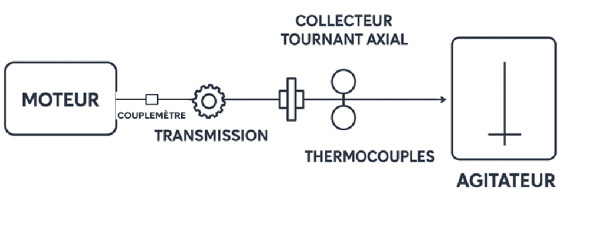
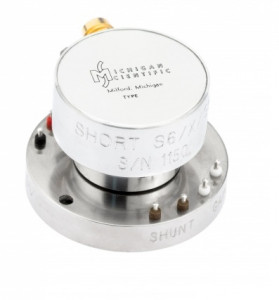
Option 3 – Torque meter on motor side + axial slip ring (mechanical modification)
Using an axial slip ring requires mechanical adaptation of the system: addition of a transmission bearing and use of a belt or gear drive. Main advantage: although the assembly must be modified, this configuration enables a significant cost reduction, as axial slip rings are more economical than radial systems or telemetry solutions.

Conclusion and customer benefits
These different configurations offer a wide range of possibilities depending on mechanical constraints, acceptable level of intrusion, and the project’s economic objectives. Depending on the priority—maintaining the existing assembly, cost reduction, or transmission performance—each solution has specific advantages. Thanks to our expertise in instrumentation and torque measurement, we support our customers in selecting and integrating the most suitable technologies to ensure reliable, safe, and consistent data acquisition in line with their process requirements.
 +33 1 46 91 93 32
 Contact form
 Subscribe to the newsletter