
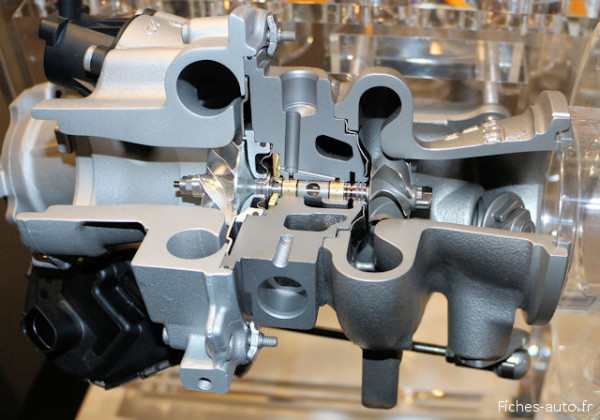
Client
Test center responsible for validating turbine, pump, and related component elements. Applications, typically in aeronautics, aerospace, or energy, may operate at ambient, cryogenic, or high temperatures. Rotational speeds generally range between 10,000 and 250,000 rpm.
Challenge
As part of a reliability study, the client identifies a major risk of wear or failure in the prototype, caused by a defect in the rotating shaft: a poorly machined, unbalanced shaft or material defect can generate vibrations in the mechanical assembly, accelerating bearing wear until complete mechanical failure.
Monitoring the shaft geometry during testing is essential to prevent any risk of failure. In static conditions, a precision comparator allows for quickly mapping the shaft profile at multiple points. In dynamic conditions, the comparator method is unusable. Additionally, the method must be non-intrusive, i.e., non-contact, to avoid biasing system operation or measurement results.
It is in this context that the client turns to PM Instrumentation.
PM Instrumentation Solution
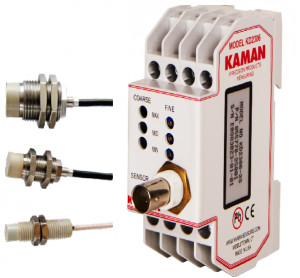
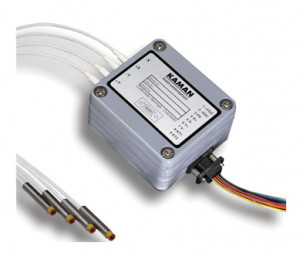
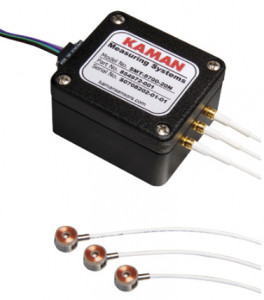
The deployed solution consists of positioning two non-contact displacement sensors from the KD-2306 series at 90° approximately 2 mm from the shaft. Each measurement processed individually will allow for measuring distance variations between the probe head and the shaft contour up to 50 kHz, enabling vibratory characterization.
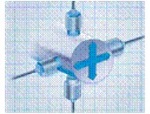
Combining the two measurements enables the determination of the shaft trajectory. An elliptical trajectory indicates runout.
Client Benefits
- Sensors are delivered calibrated with their conditioning chain, ready for installation.
- The measurement is non-contact with the shaft and ultra-repeatable.
- Multiple points on the shaft can be instrumented to monitor critical areas, and measurements can be synchronized.
- The solution operates effectively in both cryogenic and high-temperature environments, making it suitable for a wide range of advanced applications.
 +33 1 46 91 93 32
 Contact form
 Subscribe to the newsletter