
Client
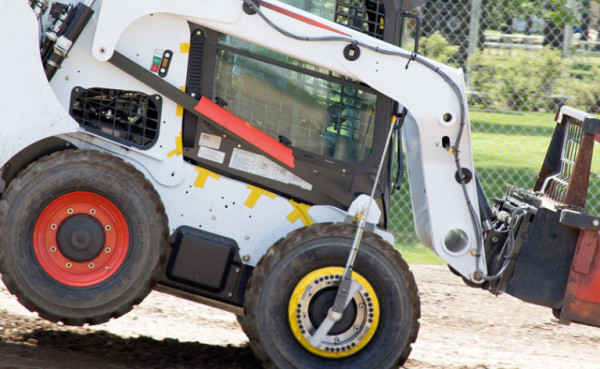
The client is a manufacturer of construction equipment. The vehicles are used in public works and mining operations. The project is part of a structural optimization program for a new platform, with objectives of reducing mass and energy consumption while meeting reliability and durability requirements.
Problematic
Mechanical sizing of a vehicle is typically based on numerical modeling and finite element simulations, occasionally recalibrated with real-world data. While this approach has enabled shorter development cycles for decades, its sometimes limited representativeness requires the use of conservative safety coefficients to account for uncertainties. This directly results in mechanical overdesign, at the expense of mass and associated costs.
Following the design review, the following technical objectives were defined by the engineering department:
- Target mass reduction: 15 to 20% with equivalent service life and loading cycles
- Limitation of physical prototypes
With the design process remaining unchanged, the only possible lever was improving simulation tools. To this end, a test campaign on a representative prototype was conducted to recalibrate simulation models and allow for reduced safety margins.
PM Instrumentation was engaged to define and provide suitable instrumentation. The key challenges included:
- Compatibility of equipment with real-world (and potentially severe) operational conditions, including shocks, vibrations, thermal effects, and dust
- The need for dynamic (>1 kHz) and multiaxial measurement to characterize load peaks and fatigue stresses at critical structural points.
PM Instrumentation Solution
A complete instrumentation system was deployed on a representative machine to measure stresses under real-world operating conditions.
Deployed Instrumentation
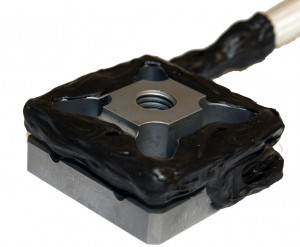
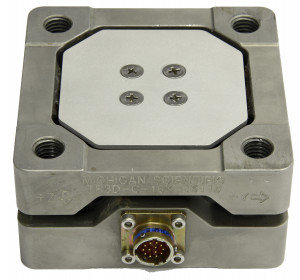
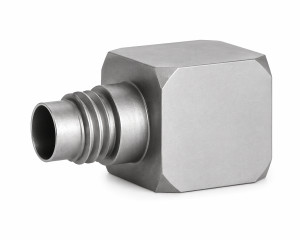
Miniature multiaxial force sensors (3 axes)
- Simultaneous measurement of forces (Fx, Fy, Fz)
- Forces: several tens of kN per axis
- Bandwidth > 1 kHz
- Integration on critical mechanical interfaces (arms, chassis, connections)
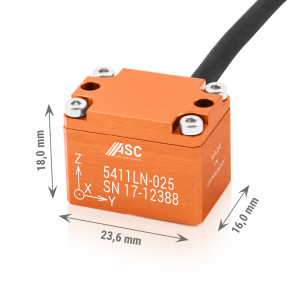
Accelerometers
- Measurement of vibration levels and shocks
- Characterization of dynamic excitations transmitted to structures
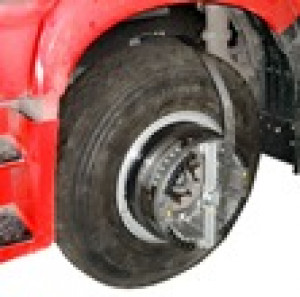
6-axis dynamometric wheel
- Measurement of forces and moments transmitted to the wheel
- Correlation of rolling loads with structural stresses
Additional Client Instrumentation
Extensometry (strain gauges)
- Local measurement of deformations
- Validation of calculated stresses and correlation with measured forces
Data Acquisition and Processing
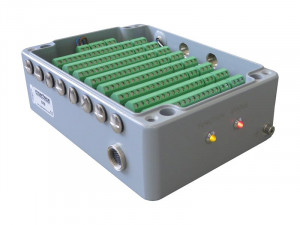
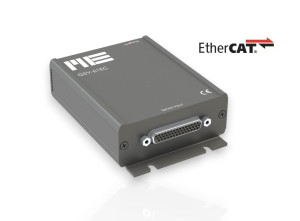
- Synchronized acquisition system, industrial environment (IP67)
- Continuous signal recording
Instrumented points were defined based on critical zones identified through FEA simulation. Data collection lasted several weeks under real-world conditions.
Results
The collected data enabled recalibration of sizing assumptions and validation of numerical models.
Key results:
- 18% mass reduction on instrumented components through section optimization and material adaptation
- Estimated 8% reduction in energy consumption over the usage cycle, linked to weight reduction
- Improved fatigue resistance through precise identification of highly stressed zones and localized reinforcement
Field measurements are now integrated into the validation process and used as a reference for sizing new platforms.
 +33 1 46 91 93 32
 Contact form
 Subscribe to the newsletter