
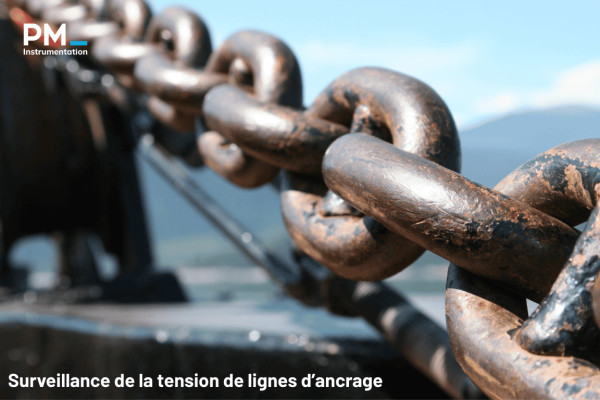
Client
A specialist in marine renewable energies, this client develops floating wind farms and offshore photovoltaic plants, subject to extreme mechanical stresses (waves, winds, currents). Their expertise covers floating structure engineering and mooring. With the growth of deep-sea projects, mastering dynamic forces on mooring lines has become a critical issue for safety, economic performance, and compliance with sector standards (DNV, IEC, API).
Problem and Challenges
Mooring lines for floating structures are subjected to complex cyclic loads (tension, torsion, fatigue), amplified by wave motion and tension variations. Their precise characterization is essential to:
- Validate numerical models (FEM simulations, fatigue analyses) and reduce design uncertainties.
- Optimize the sizing of cables and chain links, avoiding over-specification costs.
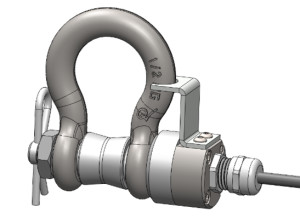
- Anticipate risks of rupture or premature degradation, particularly in connection zones (shackles, connectors).
- Comply with regulatory requirements, with traceable data for certifications (e.g., DNV-ST-0119 for floating wind turbines).
Technical challenges encountered:
- Harsh environment: corrosion, hydrostatic pressure, limited accessibility for instrumentation.
- Multi-axial dynamics: simultaneous measurement of tension, bending, and torsion forces.
- Discreet integration: sensors must withstand shocks without disrupting the hydrodynamics of the lines.
- Synchronous acquisition: synchronization of data with platform movements (via inertial measurement unit).
PM Instrumentation Solution
PM Instrumentation designed a turnkey solution for dynamic force measurement, combining:
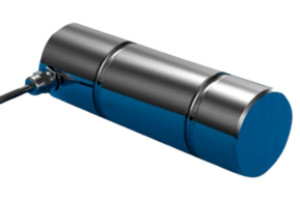
- Submersible strain gauge tension sensors (IP68 class), integrated directly into critical mooring chains. These sensors, calibrated for tension/compression, offer < 0.5% precision and shock resistance (up to 50 g).
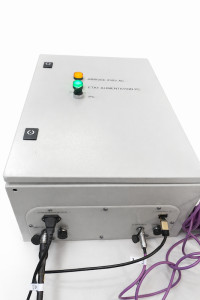
- A synchronized acquisition system (2 Hz sampling). Collected data is saved on a surface recorder and transmitted to a remote server via 4G.
- Additionally, a software platform was made available to engineers for:
- Real-time visualization of forces (tension/time curves, fatigue spectra).
- Data set downloads for analysis and reuse in simulation tools.
- Alerts in case of threshold exceedance (configurable according to project standards).
Key architecture strengths:
- Modularity: ability to add/remove sensors, support for complementary sensors (inclination, vibrations, wind, etc.).
- Robustness: seawater-compatible materials (17-4PH stainless steel, protected enclosure).
- Fully energy-autonomous solution: sensors and acquisition unit powered by photovoltaic.
Results and Client Benefits
Thanks to this solution, the client was able to:
- ✅ Reduce over-sizing costs by 20% for mooring lines by validating load assumptions with field data.
- ✅ Cut basin test times by a factor of 3 by correlating in situ measurements with numerical models.
- ✅ Obtain DNV certification for its mooring system, with a technical file reinforced by traceable data.
- ✅ Anticipate maintenance operations through fatigue cycle analysis, avoiding unplanned downtime.
 +33 1 46 91 93 32
 Contact form
 Subscribe to the newsletter