
Measuring the rotational speed of a shaft is essential for monitoring and controlling mechanical power at the shaft. However, many solutions cannot be used as they are intrusive. Here is an overview of PM Instrumentation’s solutions:
1. The gyrometer – up to 120 rpm
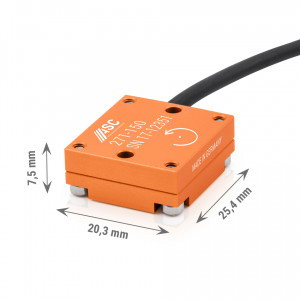
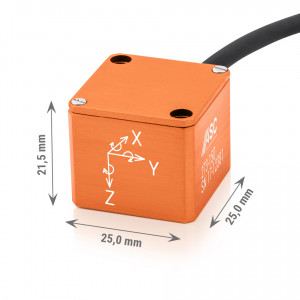
The gyrometer is an inertial sensor measuring instantaneous rotational speed. The miniature sensor generates moderate unbalance. The measurement is precise, and installation is quick (bonding or screwing). The measurement ranges allow for speeds up to approximately 120 rpm. The price is moderate. However, retrieving the measurement cable requires the use of a telemetry module or a slip ring.
Applications: test benches, wind turbines
See: ASC 271 (1 axis)
2. The slip ring with integrated angular encoder – up to 12,000 rpm
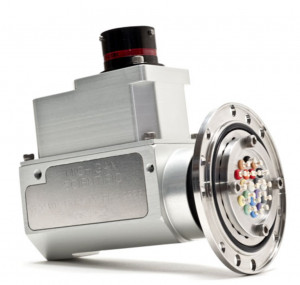
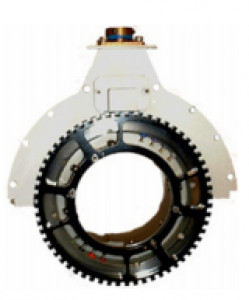
The slip ring is a very simple solution to implement, for rotational speeds up to 12,000 rpm, and is particularly useful when other measurement or moderate power signals need to be transmitted or collected to/from the rotating shaft. Installation is done on the shaft (hollow shaft version) or at its end.
Applications: test benches, vehicles, rail, compressors/pumps, etc.
See: B4-2/E60 (hollow shaft), SR/E60 (axial)
3. The eddy current sensor – up to 250,000 rpm
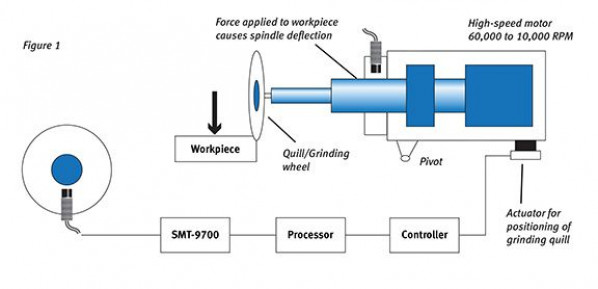
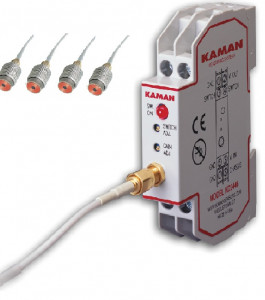
The measurement involves using a non-contact displacement sensor as a once-per-revolution marker. The sensor is positioned facing the rotating shaft (perpendicularly) and continuously measures the distance between the head and the shaft. The once-per-revolution marker is created by inserting one or more notches on the shaft. The resulting signal is a square-wave analog voltage. The instantaneous speed is obtained by dividing the number of rising edges over a reference period (1 to 10 seconds).
Acquisition cards such as counters perform these calculations automatically. The advantages of this solution are numerous: compact, non-intrusive, measurement up to 250,000 rpm, including in harsh environmental conditions. Disadvantage: does not work on a small shaft. Alternative: the sensor is positioned axially, facing a target (gear wheel) mounted on the shaft.
Applications: turbines, turbo-compressors
See: B4-2/E60 (hollow shaft), SR/E60 (axial)
 +33 1 46 91 93 32
 Contact form
 Subscribe to the newsletter