
PMIOT-VIBRA – Autonomous 3-axis IoT vibration sensor
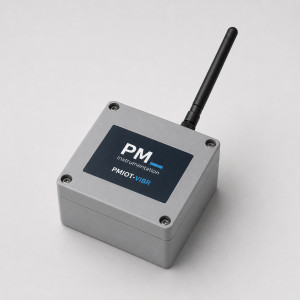
- Autonomous and connected triaxial vibration sensor
- 3-axis MEMS accelerometer integrated in the housing
- No data acquisition unit or external gateway required
- Measurement of vibration accelerations and velocities
- Automatic calculation of PPV – Peak Particle Velocity
- RMS calculation, maximum values and vibration indicators
- FFT frequency analysis and dominant frequency
- Continuous monitoring with automatic event detection
- Local recording of measurements and events
- Direct transmission via LTE-M / NB-IoT
- Automatic alerts and notifications upon threshold exceedance
- Visualization of measurements and histories in PMI-CloudVIEW
Overview
The VibraTrack – PMIOT-VIBRA is an autonomous connected vibration sensor designed for continuous monitoring of vibrations generated by construction sites, construction works, traffic, machines and industrial activities.
The housing directly integrates a triaxial MEMS accelerometer, acquisition electronics, data processing, local storage and IoT communication.
No external sensor or additional acquisition unit is required: the PMIOT-VIBRA is a complete measurement system that can be installed directly on a building, a structure or a construction.
Vibrations are measured along the three axes X, Y and Z, then processed locally to generate the indicators required for vibration analysis.
Measured quantities
The PMIOT-VIBRA makes it possible, among other things, to monitor:
- accelerations along the X, Y and Z axes
- vibration velocity
- PPV – Peak Particle Velocity
- RMS values
- maximum accelerations
- dominant frequency
- frequency content through FFT analysis
- temperature at the sensor level
- threshold exceedances
- one-off vibration events
These indicators make it possible to monitor both continuous vibrations and short events caused by impacts, works, machinery or site operations.
Onboard vibration processing
The PMIOT-VIBRA analyzes vibration signals directly at the sensor level.
This approach makes it possible to transmit only the useful data while retaining locally the detailed information required for analysis.
Onboard processing may include:
- PPV calculation on each axis
- RMS value calculation
- detection of the maximum value
- FFT frequency analysis
- identification of the dominant frequency
- calculation of vibration comfort indicators
- comparison with several threshold levels
- automatic detection of a vibration event
When a significant event is detected, the system can temporarily increase the recording level and immediately transmit an alert.
Event recording
In normal operation, the PMIOT-VIBRA periodically records the configured vibration indicators.
In case of threshold exceedance, the system can record additional information about the event to allow subsequent analysis.
Depending on the configuration, the recorded data may include:
- date and time of the event
- PPV on the three axes
- maximum acceleration
- RMS values
- dominant frequency
- frequency spectrum
- temperature
- battery level
- event waveform
This function provides both long-term monitoring and detailed information on exceptional events.
Direct IoT transmission
The PMIOT-VIBRA integrates its own IoT communication.
Data can be transmitted directly via:
- LTE-M
- NB-IoT
This architecture makes it possible to deploy a sensor without installing an additional radio gateway on the site.
Several PMIOT-VIBRA units can be installed on different buildings or structures and grouped within the same PMI-CloudVIEW project.
In case of temporary network loss, data remain recorded locally and can then be retransmitted once communication is restored.
PMI-CloudVIEW
Measurements are centralized in PMI-CloudVIEW, accessible from a web browser.
The user can, among other things:
- view current vibration levels
- display historical curves
- display the X, Y and Z axes separately
- track PPV and RMS values
- view detected events
- analyze dominant frequencies
- configure watch and alert thresholds
- receive automatic notifications
- supervise multiple sensors and multiple sites
- export data
- generate reports
- transmit data to a third-party platform via API
Thresholds and alerts
Several threshold levels can be configured according to the application.
For example:
- normal level: operation within defined limits
- watch threshold: significant increase in vibrations
- alert threshold: exceedance requiring verification or intervention
When an exceedance occurs, the PMIOT-VIBRA can:
- automatically record the event
- immediately transmit the results
- trigger a notification
- retain the detailed data for analysis
Thresholds are defined according to the structure, the environment and the project requirements.
Standards and use of measurements
The system can be configured to produce the indicators used in various vibration monitoring standards.
Depending on the configuration and the chosen validation, data can in particular be used for monitoring based on:
- DIN 4150-3 – effects of vibrations on structures
- BS 7385-2 – evaluation of vibrations on buildings
- ISO 2631-2 – human exposure to vibrations in buildings
- French circular of 23 July 1986 – vibrations transmitted to buildings
- standards specific to railway infrastructures or specific projects
The choice of thresholds and of the standard must be defined according to the application and the project requirements.
Applications
- vibration monitoring of construction sites
- earthworks
- pile driving and vibro-driving
- drilling and underground works
- demolition
- works near sensitive buildings
- building monitoring
- historical monuments
- bridges and footbridges
- tunnels
- railway lines
- civil engineering structures
- industrial infrastructures
- monitoring of traffic-induced vibrations
- impact monitoring
- vibration comfort control
- temporary or permanent monitoring
Advantages
- all-in-one system
- no external sensor
- no mandatory gateway
- quick installation
- triaxial measurement
- processing directly at the sensor level
- secure local storage
- automatic event detection
- long-range IoT transmission
- autonomous operation
- remote supervision
- automatic alerts
- easily extensible architecture
- installation possible on multiple sites
- Vibration
- Application
- Civil Engineering, Building, Bridge, Process
PMIOT-VIBRA housing
The PMIOT-VIBRA is integrated in a compact industrial housing combining the sensor, acquisition, storage, power supply and communication.
- Format: compact autonomous housing
- Sensor: integrated triaxial MEMS accelerometer
- Antenna: external or integrated depending on the version
- Mounting: directly on the structure
- Use: indoor or outdoor
- Protection: IP67
Options
- configurable measurement frequency
- configurable transmission frequency
- various threshold levels
- LTE-M / NB-IoT transmission
- IoT SIM card
- extended local storage
- waveform recording on event
- PPV calculation
- RMS calculation
- FFT analysis
- dominant frequency calculation
- vibration comfort indicators
- temperature measurement
- internal humidity measurement
- local Bluetooth configuration
- enhanced time synchronization
- GPS synchronization depending on the version
- external power supply
- long-life battery
- solar power supply
- SMS / e-mail notifications
- automatic reports
- integration in PMI-CloudVIEW
- transmission to a customer server via API
- specific configuration according to the project standard
Accessories
- mounting plate
- wall bracket
- screws and anchors
- remote antenna
- replacement battery
- solar panel
- transport case
Related products
 +33 1 46 91 93 32
 Contact form
 Subscribe to the newsletter