
SiloTrack – Automated silo weighing and monitoring solution
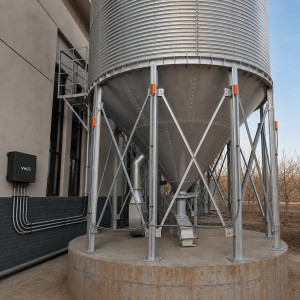
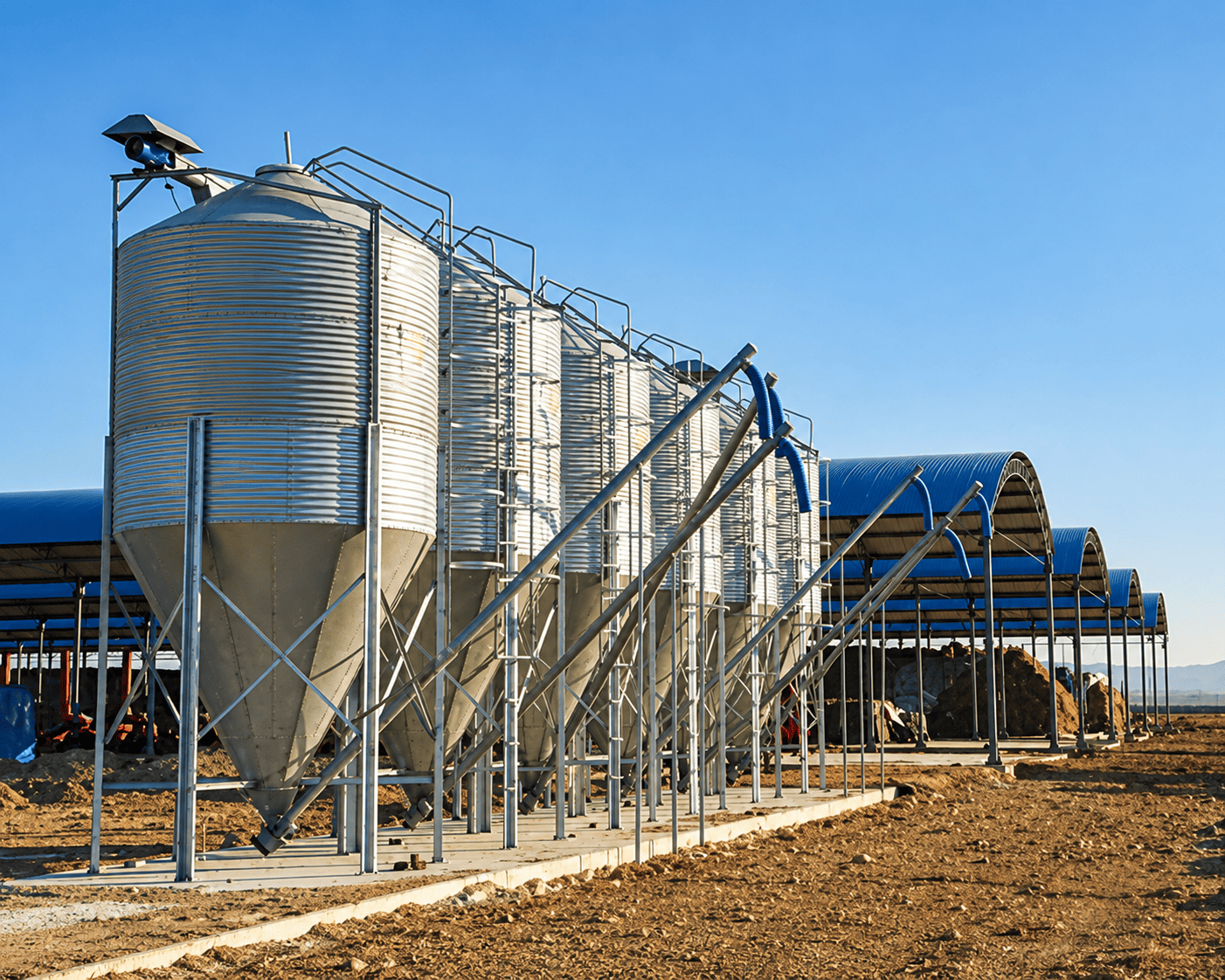
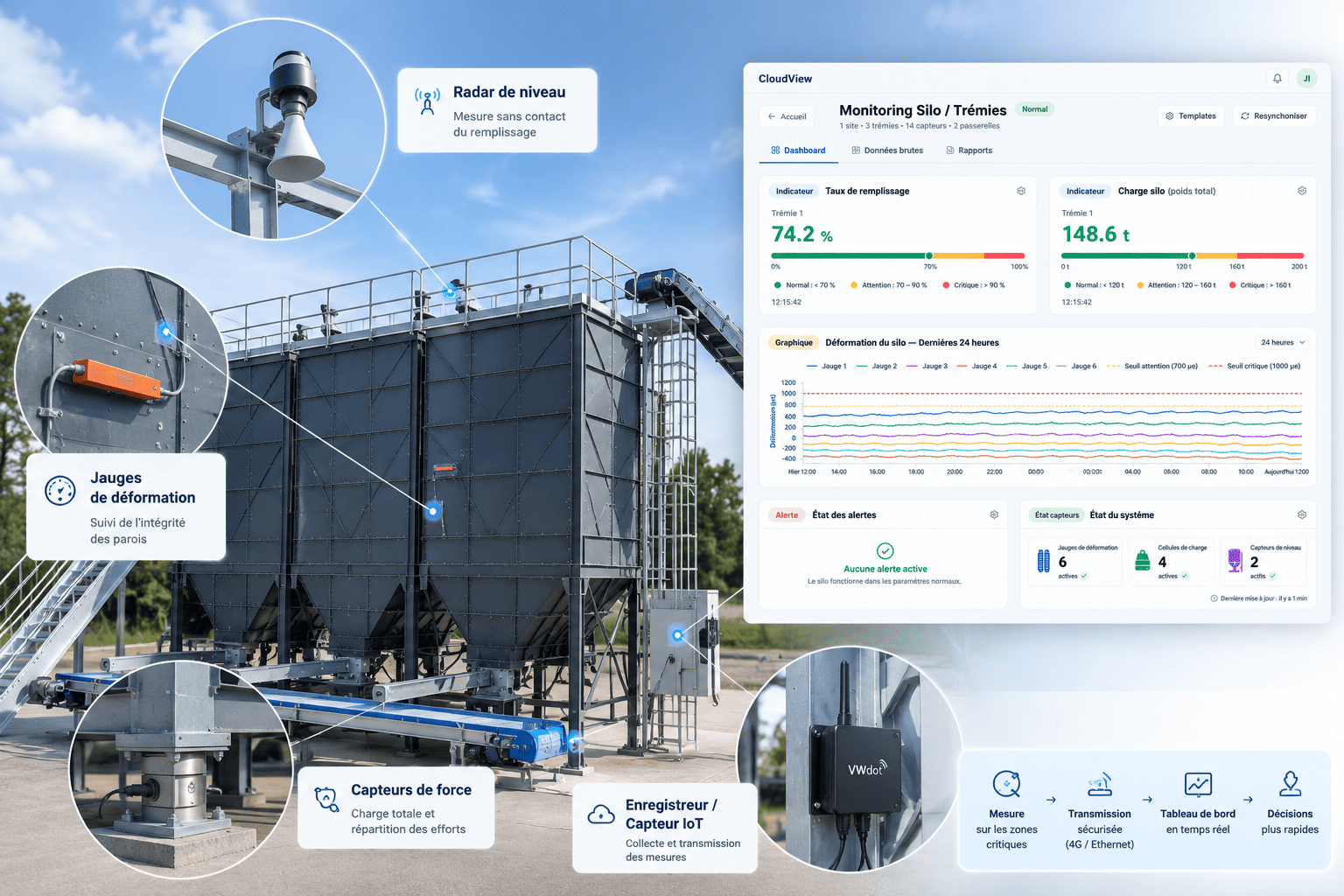
- Automated monitoring of silos and tanks
- Load measurement using high-resolution strain gauges
- Installation on the feet of the existing silo, with no major structural modification
- On-site calibration
- Monitoring of total load and its distribution across the supports
- Local wireless data transmission
- Data upload via Wi-Fi, Ethernet or 4G depending on the configuration
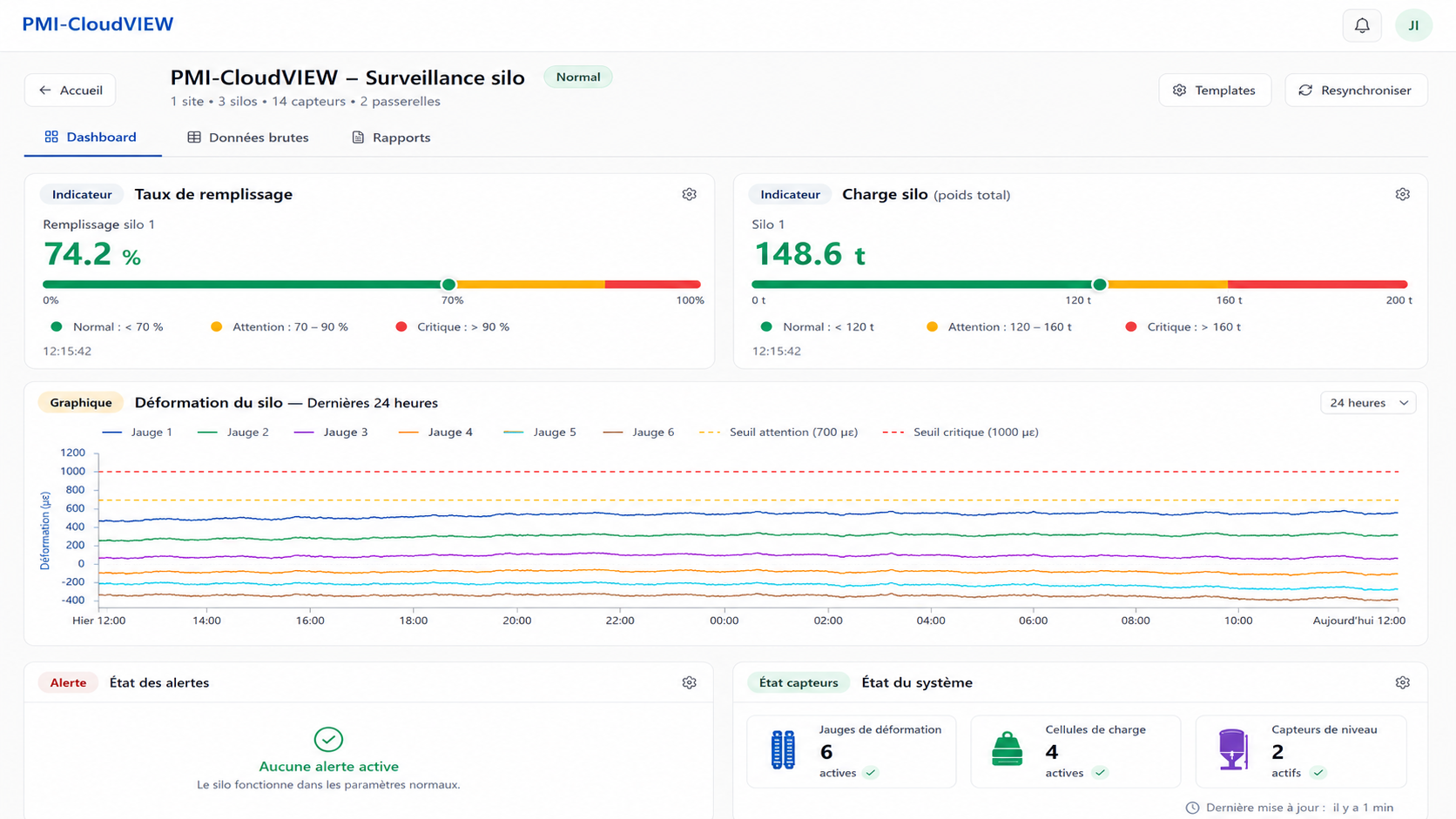
- Visualization from a web browser
- Configurable curves, thresholds, alerts and notifications
- Data logging and export
- Simultaneous monitoring of multiple silos
- Multi-user access from a computer, tablet or smartphone
- Solution suitable for outdoor installations
Overview
SiloTrack is a complete measurement and supervision solution designed to continuously monitor the load of industrial silos, hoppers and tanks.
Strain gauges are installed directly on the feet or load-bearing elements of the silo. When the quantity of stored product changes, the load applied to the structure causes a very small deformation of the supports. The sensors measure this deformation in µm/m, and the system then converts it into an estimate of the load contained in the silo.
This method makes it possible to instrument existing silos without installing load cells under the feet and without making major modifications to the structure.
After installation, on-site calibration is used to establish the relationship between the measured deformations and the actual load of the silo.
SiloTrack notably makes it possible to:
- track the quantity of stored product
- visualize filling and emptying phases
- detect overloading
- compare forces across several feet
- identify a loading imbalance
- monitor the evolution of the structure's behavior
- keep a history of operations
- reduce manual readings on site
Measurements are acquired automatically and then transmitted to a remotely accessible supervision platform.
Strain gauges
The strain gauges are fixed directly onto the feet or load-bearing elements of the silo. They measure the very small deformations generated by load variations.
Two technologies can be offered depending on the support and installation constraints:
- bondable strain gauge, compact and suitable for prepared surfaces
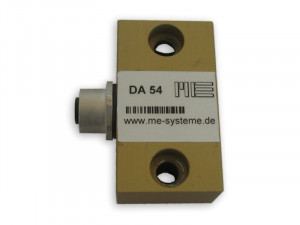
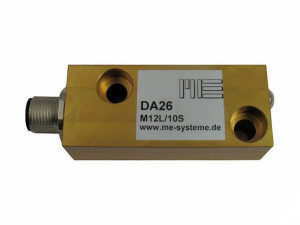
- screw-on strain gauge, facilitating mechanical mounting and replacement
The number of sensors depends on:
- the number of silo feet
- the geometry of the structure
- the required accuracy
- the expected load distribution
- access possibilities to the instrumented areas
A temperature probe can be added to compensate for or correlate variations related to thermal conditions.
Acquisition node
The acquisition node measures the signals coming from the strain gauges and periodically transmits them to the gateway.
It is installed close to the sensors in order to limit cable lengths and simplify deployment.
Depending on the configuration, the node handles:
- sensor power supply
- deformation acquisition
- measurement conversion and timestamping
- temporary data storage
- wireless transmission to the gateway
- system status diagnostics
- reporting of temperature and power supply status
Gateway
The gateway centralizes the measurements coming from the various nodes installed on one or more silos.
It then handles data transmission to the remote server using the communication means available on site:
- Wi-Fi
- Ethernet
- 4G
- client's IT network
A single gateway can centralize several measurement points, depending on radio range, site architecture and the number of instrumented silos.
In the event of a temporary communication interruption, measurements can be stored locally and then retransmitted once the connection is restored, depending on the chosen configuration.
Web interface
SiloTrack data is accessible from a secure web interface, with no specific software installation required.
From a computer, tablet or smartphone, the user can:
- view the current load of the silo
- visualize the fill level
- track filling and emptying cycles
- compare measurements from several feet
- supervise multiple silos from a single interface
- view historical curves
- configure warning and alert thresholds
- receive notifications
- export data for analysis or reporting
- check the status of sensors and communications
Dashboards can be adapted to the needs of operations, maintenance or inventory management teams.
Installation and commissioning
SiloTrack installation is carried out directly on the existing structure.
Implementation generally includes:
- analysis of the silo geometry
- identification of measurement areas
- surface preparation
- strain gauge installation
- installation of the acquisition nodes
- gateway setup
- communication checks
- calibration with a reference load
- dashboard configuration
- definition of thresholds and notifications
On-site calibration is an important step, as the relationship between the measured deformation and the load depends on the geometry, materials and mechanical behavior of each silo.
- Force & Load, Distortion
- Application
- Silo
Options
- bondable or screw-on strain gauges
- number of measurement points
- temperature measurement
- mechanical protection of sensors
- cable lengths
- mains, battery or solar power supply
- Wi-Fi, Ethernet or 4G transmission
- remote antenna
- local data storage
- configurable measurement frequency
- configurable transmission frequency
- custom thresholds and notifications
- multi-silo dashboard
- automatic data export
- transmission to a client server via API
- periodic reports
- on-site calibration
Accessories
- strain gauges from the DA series
- mounting plates and fixing accessories
- cables and extensions
- connectors and cable glands
- junction boxes
- acquisition nodes
- communication gateway
- external antenna
- mains power supply
- external battery
- solar power kit
- temperature probe
- protective enclosure
- wall or pole mount
 +33 1 46 91 93 32
 Contact form
 Subscribe to the newsletter